Key points
63% expect Q-Day within three years
97% are taking action to protect themselves from quantum risk
63% are concerned about machine-to-machine cyber threats
98% are upgrading defences against those threats
68% are confident they can respond before disruption
London, 26 November 2026 – The countdown to quantum risk is accelerating faster than businesses anticipated, according to new research from digital infrastructure company Colt Technology Services. 63% of organisations questioned expect Q-Day to arrive within just three years, while 97% are already taking action to prepare for quantum-related cyber risk as they confront a new generation of machine-driven threats.
The insights come from Colt’s latest IT Priorities research, which surveyed 1020 IT leaders in ten countries in Europe, Asia and the Americas.
New wave of cyber threats sparks concern alongside historic shift in internet traffic
Among those concerned about quantum risk, almost one in four say they are ‘extremely concerned’. Their greatest fear is the potential exposure of automated machine-to-machine and IoT communications, cited by 61%, followed by “harvest now, decrypt later” attacks at 60%.
Half the businesses surveyed name AI-driven cyber threats as one of their top three concerns, with 63% worried specifically about machine-to-machine cyber threats. This concern comes as one major measure of online activity reaches a tipping point: in June 2026, bot-driven HTML requests overtook human-generated requests for the first time in history, according to data from Cloudflare. As the internet - and its connecting infrastructure - shifts from human-driven to machine-driven, businesses face a fundamental change in the scale and speed of cyber risk, with major implications for IT defences, infrastructure and resilience.
Businesses are acting quickly, but a confidence gap remains
Almost every business in the Colt survey is upgrading its defences against machine-to-machine threats, but this action is not reflected in confidence: while 98% are strengthening their defences, only 68% are confident they can detect and respond to an AI-driven threat before it causes disruption. Confidence falls to 61% in APAC, compared with 76% in the US.
Businesses are also preparing for quantum risk, taking two to three actions on average, from upgrading cryptographic systems to implementing post-quantum encryption. AI-driven threats are prompting similar changes to network security, including AI behavioural analytics, specialised bot and API tools and zero trust for non-human identities.
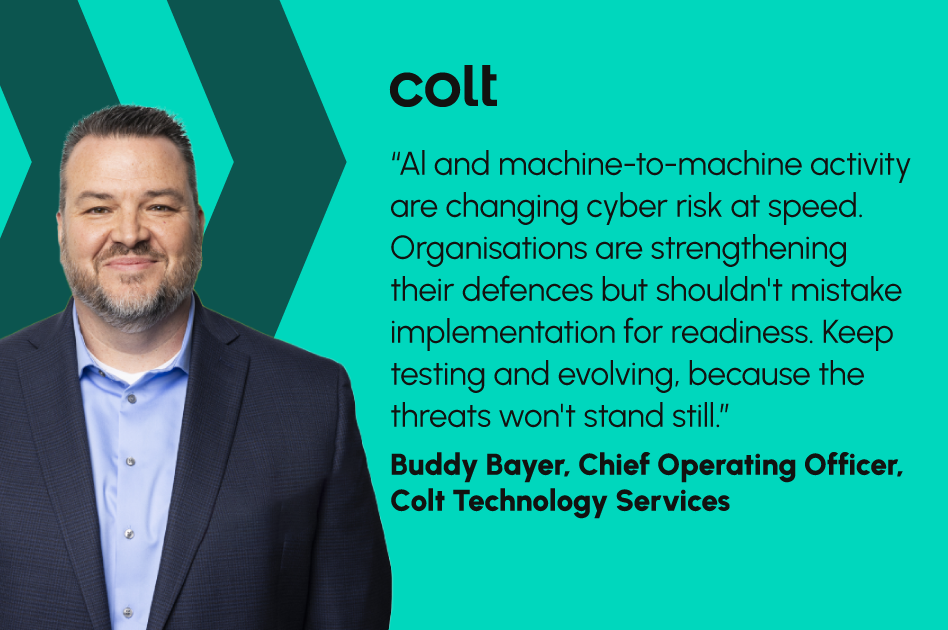
Buddy Bayer, chief operating officer, Colt Technology Services, said, “Businesses are entering a new era of cyber risk. AI and machine-to-machine activity are changing not only the volume of threats, but their speed and complexity. Organisations are moving quickly to strengthen their defences, and that’s encouraging, but confidence hasn’t caught up with deployment. The message is simple: don’t mistake implementation for readiness. Keep testing, keep talking to your partners and keep evolving your defences, because the threat landscape won’t stand still.”
- Ends -
Methodology
Intuit Research surveyed 1020 IT decision makers and influencers responsible for digital infrastructure services, from companies with annual revenue of €500m+ and 1000+ employees. 100 respondents were questioned in the US, UK, Germany, Spain and Hong Kong, in addition to 102 in Singapore, 103 in Japan, 104 in the Netherlands, 105 in Italy and 106 in France.