Contributors

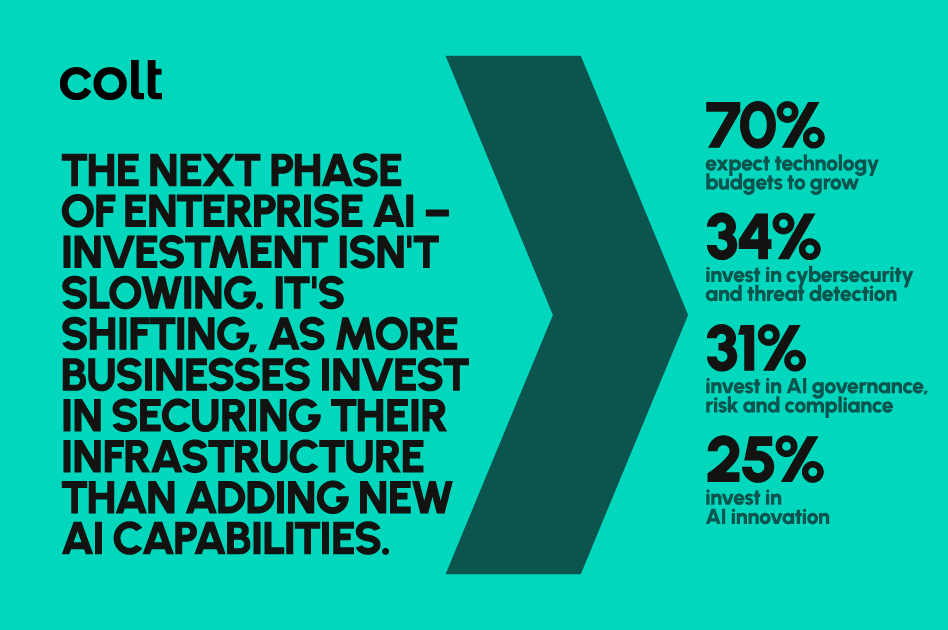
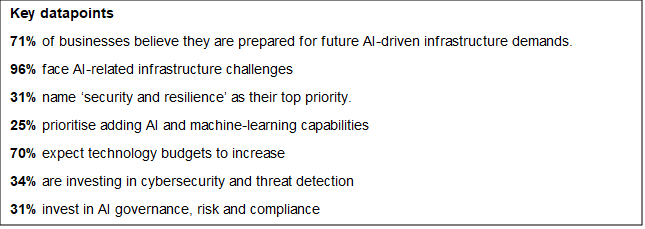
London, November 12th 2026 – The enterprise AI race is entering a new phase as businesses shift their focus from adopting AI to securing the infrastructure beneath it, according to new research from Colt Technology Services among 1,020 IT leaders across ten countries in Europe, Asia and the Americas. Improving security and resilience is now named as a top priority by 31% of businesses, while adding new AI and machine learning capabilities has fallen nine percentage points year-on-year to 25%.
The shift comes as AI puts increasing pressure on enterprise infrastructure. While 71% of businesses believe they are prepared for future AI-driven demands, 96% say AI is already creating infrastructure challenges.
AI investment shifts towards security and governance
Investment patterns reinforce this shift from innovation to governance. Businesses are still spending: 70% of businesses in the study expect technology budgets to grow over the next three years, with Asia driving this growth. However, priorities are shifting from adopting AI towards securing, governing and building the infrastructure needed to support it.
More than one in three businesses (34%) is investing in cybersecurity and threat detection, while 31% are investing in AI governance, risk and compliance.
The research uncovers a regional divide: businesses questioned in Asia and Europe are directing AI investment towards protection and compliance, while US enterprises are placing greater emphasis on process optimisation and product innovation.
Almost every business reports AI infrastructure challenges
As AI integration reshapes infrastructure demands worldwide, almost all enterprises questioned (96%) say AI has created infrastructure challenges for their organisation.
Four in ten businesses cite greater cybersecurity exposure as a challenge, rising to 47% in Asia. Other challenges include increased network traffic at 39%, greater bandwidth requirements at 37%, increased cloud-connectivity requirements at 36%, and demand for lower latency and greater automation, both at 35%.
Confidence remains high despite current pressures
Confidence varies considerably by region. While 71% of businesses surveyed feel prepared to meet future AI infrastructure demands over the next two to three years, confidence rises to 77% in the US and 74% in the UK and Europe, compared with 64% in Asia.
Buddy Bayer, chief operating officer, Colt Technology Services, said, “The first phase of enterprise AI was about getting AI through the door. The next is about making sure the infrastructure can cope when AI scales. Our research shows that AI is already testing the infrastructure beneath it, from cybersecurity and network traffic to bandwidth and latency. Businesses may feel ready for AI, but confidence alone won't carry the next wave of adoption. The winners will be those that build security, resilience and connectivity into their AI strategy from the start.”
Methodology
Intuit Research surveyed 1020 IT decision makers and influencers responsible for digital infrastructure services, from companies with annual revenue of €500m+ and 1000+ employees. 100 respondents were questioned in the US, UK, Germany, Spain and Hong Kong, in addition to 102 in Singapore, 103 in Japan, 104 in the Netherlands, 105 in Italy and 106 in France.