Contributors

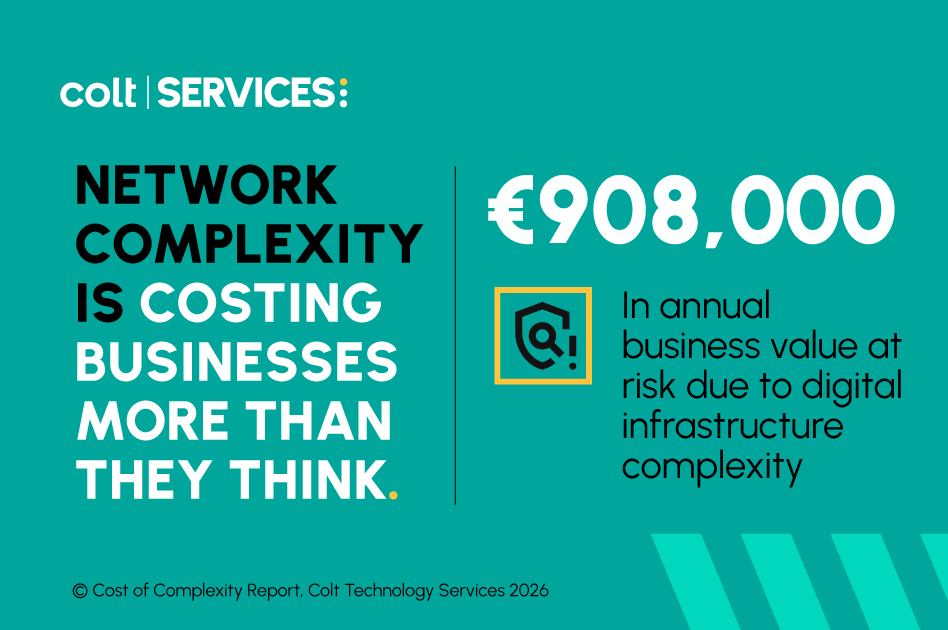
Complex digital infrastructure is putting nearly €1 million a year of growth and innovation potential at risk, new proprietary research from Colt Technology Services reveals today. More than €400,000 is at stake annually due to delays and rework caused by this complexity, with a further €508,000 tied up in stalled innovation initiatives. Together, this means nearly €1 million in business progress and innovation potential is held back each year.
The research, outlined in a report entitled ‘The Cost of Complexity: why simplifying digital infrastructure accelerates enterprise growth’ surveyed senior leaders in 600 large organisations across the UK, France, Germany, the Netherlands and Japan.
Key findings at a glance
- Nearly €1m/year at risk: €401,400 lost annually to delays and rework, plus €508,000 tied up in stalled innovation initiatives.
- AI adoption stalling: 60% say complexity blocks them from realising AI's full benefits at scale; 66% believe they've missed AI opportunities.
- Seven weeks lost: complexity created the equivalent of seven weeks of business delays over the past 12 months.
- UK hit hardest: UK businesses reported the highest financial impact at €450,400, ahead of Germany and France.
Survey respondents said they experience a number of different sources of network complexity - including managing multiple vendors (named by 57%), running legacy systems (48%) and managing security and compliance requirements (36%) - resulting in internal costs, slow progress on projects, increased costs from suppliers, delayed revenues and security and compliance risks.
Impact on AI progress
AI adoption is stalling due to complex, fragmented infrastructure. 60% say digital infrastructure complexity is a barrier to embracing the full benefits of AI at scale. Two thirds (66%) believe businesses have missed AI opportunities.
Financial impact
When asked to consider the financial impact1 of this complexity on their business, respondents estimated value at stake of around €401,400 over the past 12 months as the result of delays to business progress, with UK businesses in the survey citing the highest in the study at €450,400 (£387,400) - around 12% above the survey average - followed by Germany (€445,400) and France (€429,000). Businesses in Japan cited €405,000 (c. ¥75,800,0002) and the Netherlands estimated value at stake of around €255,300 over the past year. More than one in two (57%) businesses surveyed agree that businesses are losing revenue every year because their digital infrastructure cannot keep up with business ambition.
In addition, in the past 12 months, the large companies surveyed said they were unable to progress 14 innovation initiatives at least in part due to digital infrastructure complexity. The average annual value of these stalled initiatives was cited at an average of €508,000. UK businesses cited the biggest impact at €743,600 (£635,500), closely followed by France (€753,000), with Germany citing €554,700, the Netherlands €335,100 and Japan €229,900 (¥39,288,800).
Impact on time
Complex digital infrastructure is slowing critical business operations, from expansion to transformation, creating the equivalent of seven weeks of delays across the past 12 months
91% of businesses report that this complexity has created delays in embracing emerging technologies such as Agentic AI, rising to 100% in Japan, with slightly lower figures in the UK (88%), Germany (88%) and France (86%). 93% say complexity has resulted in delays to M&A integration, 84% to market expansion, and 83% to product launches. More broadly, 56% say complexity is holding back innovation, 44% report increased operational costs, and 39% say it is preventing revenue growth.
Laura Farina, EVP – Enterprise Sales, Colt Technology Services said, “Many complex enterprise networks have been built over time like LEGO bricks from different generations – compatible in theory, but not designed to form a clean, stable structure together. This complexity is now having a real financial and operational impact among the large companies we surveyed, slowing AI adoption and putting future growth at risk.”
Key takeaways
Organisations that simplify their digital infrastructure are better positioned to drive financial performance and scale AI successfully. Achieving this depends on the following foundations
• Simplification must be continuous: treat it as an ongoing design principle, not a one-off clean-up
• Balance is critical: organisations need to simplify legacy systems while continuing to innovate and transform in parallel
• Avoid adding complexity: new tools, platforms, and vendors should reduce friction, not create new silos or layers
• Modernise and retire simultaneously: replace or consolidate legacy systems as new ones are introduced to prevent buildup
• External support is often needed: many organisations seek outside expertise due to fears of disruption and complex system dependencies
Laura said, “Colt helps IT leaders simplify their digital infrastructure by taking friction out of the network itself, through cleaner design, fewer moving parts, automation, and infrastructure built for modern demands like AI. The result is networks that are secure, scalable and ready to help businesses grow, compete and thrive in the AI economy.”
Frequently asked questions
How much does digital infrastructure complexity cost enterprises?
Almost €1 million a year in lost growth and innovation potential - €401,400 from delays and rework, and €508,000 from stalled initiatives, per Colt's survey of 600 senior leaders across five countries.
How is AI adoption affected by infrastructure complexity?
60% of businesses say complexity is a barrier to realising AI's full benefits at scale, and 66% believe they've missed AI opportunities as a result.
Which countries report the highest cost of complexity?
The UK reported the highest impact (€450,400), followed by Germany (€445,400) and France (€429,000), with Japan (€405,000) and the Netherlands (€255,300) lower.
1 This figure is the average estimated annual value at stake for businesses from delays caused by complex digital infrastructure. It is based on reported delays or rework to strategic initiatives such as entering a new market, M&A integration, product and service launches, workload migration, compliance or security requirements, and embracing emerging technologies such as Agentic AI.
2 Using conversion rate of €1 = ¥184.6–¥184.7
Figures rounded to nearest 100.
Digital infrastructure in the questionnaire referred to ‘networks and network security, unified communications and cloud platforms’.
‘Innovation initiatives’ are defined as any new or significantly improved idea, project, product, service, process, or business model proposed, piloted, or implemented with the goal of creating measurable business value or competitive advantage.
Notes to editors
Research Methodology
Coleman Parkes surveyed 600 CEOs, CIOs, CTOs and IT directors within organisations across the UK (117 businesses), France (117), Germany (116), the Netherlands (100) and Japan (150) with an average of 26,055 employees. The research was carried out in February and March 2026.