Contributors




As focus shifts from Gen AI to agentic, many organisations are still pinning down their AI strategy. But defining the approach is only the beginning: successfully moving AI from pilot to company-wide deployment is a major challenge, with only 6% managing to make it work at scale. Fragmented, complex legacy infrastructure is one of the main culprits, but this has implications that go well beyond AI.
Pilot AI projects tend to go smoothly because they’re limited in scope. These initiatives are often carried out in a single, controlled environment that doesn’t drive significant complexity. They’re chosen because they’re straightforward to deploy: few dependencies and integrations, one or two teams, and limited legacy tech to navigate.
But this doesn’t reflect the reality of wider deployment. As one VP at a transportation company said to us recently, “When we roll out the solution into multiple sites or different countries, then the real picture comes out. Every location has a different set-up, client systems are different – and this is the time when complexity becomes clear.”
There are many factors at play here, like poor data quality, inadequate governance and ineffective change management, but one of the major issues is complex, disjointed and legacy infrastructure.
More than four out of five (82%) organisations in our recent survey say that their networks, security, Unified Communications and cloud systems are not fully integrated; and two-thirds have failed to exploit AI opportunities because of limitations in their infrastructure.
AI demands performance guarantees and a breathable ecosystem
If we look at what AI needs from enterprise infrastructure, it’s obvious why complexity and legacy are a problem.
Supporting agentic AI isn’t just about bandwidth. Although this plays a role, it’s not as important as low latency, guaranteed and consistent performance, and integrated, secure but breathable infrastructure.
One of our manufacturing customers, for example, has a static MPLS network with siloed factories, air-gapped OT and security based on the outdated perimeter model.
To get more value from the company’s data and to safely drive AI into its workflows and supplier ecosystem, the manufacturer needs to:
• Converge IT and OT without increasing risk
• Remove silos between systems and locations
• Guarantee network performance and responsiveness
• Secure data flows from plant to cloud and across geographical borders
• Strengthen security while allowing users, AI agents and suppliers to access the information and systems they need
The company’s current legacy infrastructure is complex and poorly integrated, and simply can’t support these objectives. Its perimeter-based security model wasn’t designed for today’s operational models and working practices. Poor visibility compromises performance and creates blind spots and vulnerabilities. And it can’t possibly provide the flexibility and guaranteed performance levels that complex multi-agent workflows need to function.
How has enterprise infrastructure become so complex?
Legacy infrastructure was designed for a different operational model
Many organisations are still working with legacy infrastructure because until relatively recently, their application landscape and operational model didn’t warrant the transition.
But that’s changed in recent years. The Covid pandemic forced many organisations to adopt SaaS and cloud models to enable home working (although sovereignty concerns are now forcing them to rethink these strategies). Hybrid working and BYOD have become standard in many organisations, with all the associated connectivity and security challenges.
In response, IT teams are playing catch-up. They’re effectively attempting to reverse-engineer legacy infrastructure to support this new application landscape and fresh ways of working.
This often involves workarounds and temporary fixes which add to the fragmentation and complexity. There’s rarely time for teams to stop, review and optimise infrastructure; so configuration drift, tool sprawl and technical debt make the situation even worse.
The average enterprise estate now relies on 16 different vendors, platforms or tools, so comprehensive oversight is almost impossible and accountability isn’t always clear.
M&A activity
In some sectors, mergers and acquisitions play a major part in infrastructure complexity. Disparate systems and infrastructure layers that don’t easily align must be integrated cost-effectively and within challengingly short timeframes, often repeatedly.
Shadow AI
Publicly available AI platforms have become a staple tool for many employees, who don’t realise the risks of plugging sensitive information into them. This adds a new level of complication, as security frameworks battle to balance governance with employee productivity.
How can enterprises simplify and modernise their digital infrastructure?
These changes in the way businesses operate are driving a shift away from rigid, fixed legacy infrastructure towards streamlined, software-defined fabrics, zero trust frameworks and flexible on-demand services. Getting there isn’t easy, but there are some key approaches that help boost the success of these transformation projects.
Don’t start with the tech
Because transformation initiatives are often driven by the IT department, they tend to start with discussions around technology, products or solutions.
But the conversation needs to zoom out to a more strategic level. It should examine in detail the organisation’s vision, goals and challenges, alongside what the competition is doing and what’s happening in the sector. This needs to take place before even beginning to look at how technology can enable the end goals.
One of our manufacturing clients, for example, realised it had the assets and skills to pivot into a promising new field and establish itself as a major player in this fresh area. To help it build digital infrastructure that could support its ambitions, we needed to start by understanding what the business was aiming to achieve as clearly as their CxOs and department heads did.
That level of understanding needs more than just the IT team in the room: it requires stakeholders from across the business to give input from the very beginning. Each stakeholder will have a different view on what the goals and the challenges are, and together they build a comprehensive picture of where the transformation journey needs to go.
Don’t skimp on the roadmap
Once a target end state has been designed, a detailed and highly realistic roadmap needs to be developed based on the answers to some core questions:
• Where are we now and how long does the transformation journey need to be? (Moving from MPLS to SASE will probably be more involved than moving from SD-WAN to SASE, for example.)
• What’s the health of our current infrastructure? For example:
o Latency: can we guarantee response times for real-time AI agents?
o Bandwidth: are we ready for high-bandwidth Ethernet for data-heavy AI models?
o Jitter: can we provide the stability to support large volumes of GPUs working in sync?
• What are the workload, security and networking demands of the use cases we’ve identified? (Fraud detection in finance, for example, requires jitter-free transit to make sure the signals that block transactions arrive before the transaction clears.)
• How can we transform safely while still generating revenue? What are the risks and how do we mitigate them?
• What’s the timeline? Does it suit our business goals, our budget and our attitude to risk to go faster or to take a gradual, phased approach?
• What resources do we have to get this done? Can we do this in-house or are there gaps in skills, experience or headcount?
• What regulatory compliance, ESG and sovereignty needs have to be accommodated?
Zero trust is a mindset, and needs expertise
To support AI, disparate networking, cloud and security systems need to be brought together into a simpler and more cohesive architecture.
Most businesses were already navigating the shift from legacy infrastructure and perimeter-based security to software-defined networking and zero trust when AI became an imperative. The goalposts shifted mid-journey, creating further complexity.
Adopting zero trust isn't straightforward. Aligning to its principles requires a complex cultural and technological transformation; it isn’t an off-the-shelf product. And now it needs to be designed for a model where AI agents demand real-time access to data and systems across the organisation. But at the same time, vulnerabilities have to be locked down, networks must be segmented to stop lateral movement, and updates, governance and policies need to be consistently applied over the entire enterprise estate.
This is a big task, so many organisations are turning to third-party providers for the relevant skills and expertise. In fact, as many as three-quarters of enterprises (73%) would consider an external review to help them transform.
Choosing who to work with is an important part of this process. Many organisations will look for partners that can help them understand what the technology evolution to the target end state needs to look like, that have a solid understanding of their sector’s regulatory demands, can operate globally and at scale and will support data sovereignty.
Vendors with a broad partner ecosystem are also well-placed to help organisations source the expertise for broader technical and non-technical challenges, like structuring data, model training and change management.
Use NaaS to support business outcomes
Fixed, legacy connectivity services are too rigid to accommodate AI workloads, which rely on highly distributed storage and compute resources. With its on-demand consumption model, Network as a Service (NaaS) offers much more flexible and scalable connectivity for AI deployments.
NaaS allows enterprises to add new connections and dial services up and down in real time, so they can personalise their networks to the demands of AI without the CAPEX, long lead times and hardware lifecycle management ramifications of legacy connections.
As new AI resources are put in place, they can be connected instantly. NaaS also enables deterministic and intent-driven networking, so connectivity can prioritise business outcomes like power efficiency; very low latency so distributed workloads and workflows can run at optimum performance; and geographical routing for sovereignty purposes.
Remember that innovation can’t be shelved
Most organisations can’t afford to put everything on hold until transformation is fully complete, so plans need to accommodate in-flight IT initiatives too.
But as a CIO at a German manufacturing organisation told us in our recent survey: “You also can’t just keep stacking new tools and AI initiatives on top of existing complexity, because that only creates modern silos instead of removing them.”
This means a balance has to be found between innovation and progress, and simplification and modernisation.
Complexity isn’t just a problem for AI
While 84% of organisations are increasing AI investment, only 13% are seeing returns within a year, and inadequate infrastructure is a leading cause. This in itself is worrying, but AI isn’t the only initiative that’s driving enterprise transformation plans.
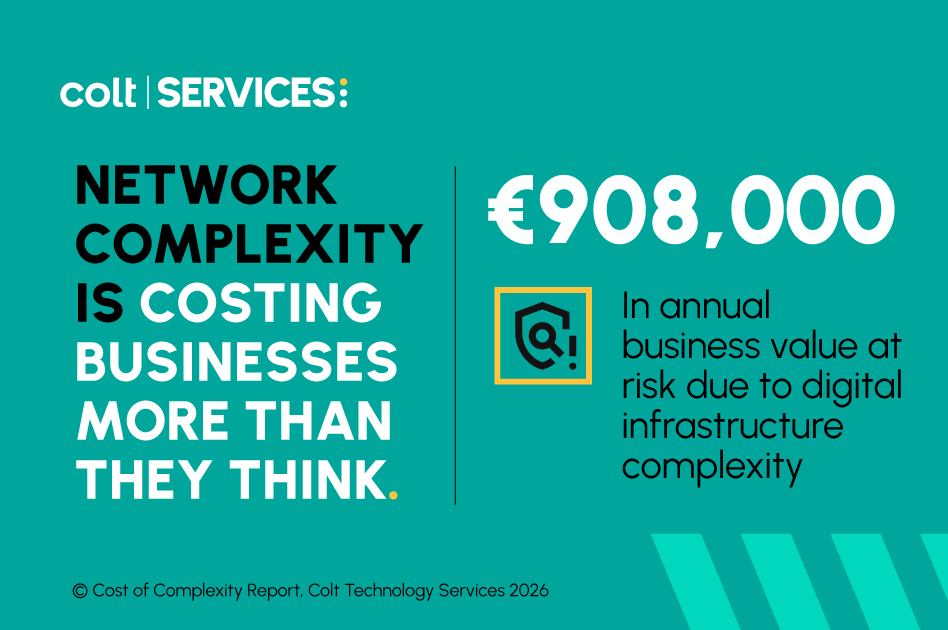
The problems created by complex legacy infrastructure go way beyond technology; by holding back wider innovation and limiting competition, this has become a board-level issue. It creates vulnerabilities and makes change difficult and risky, stifling ambition and impacting organisational confidence. In fact, 68% of enterprise leaders believe that infrastructure complexity is even more of a barrier to growth than a lack of funding or ideas.
Complex legacy infrastructure has become a strategic liability beyond the confines of AI deployment, and this gives the need for transformation a whole new level of urgency.
Learn more about infrastructure complexity by checking out our website.