Contributors

Solutions


The role of top-level technology executives has evolved from the day-to-day management of an organisation’s IT to something far more strategic. CIOs, heads of infrastructure and network managers are now responsible for decisions that are central to the success of the business. Their job is to navigate complex technology options and then deploy them, helping the business to grow and compete. Their choices can be game changers, for better or worse.
Our customers have a wide ranges of objectives, from modernisation and cost reduction to simplification and automation. They’re faced with ever growing customer expectations, all while having to meet stricter global legislation. It’s the same story with digital infrastructure partners too. They’re battling complexity, juggling modern innovations while rapidly delivering services to enable their own customers. Environmental, social and governance (ESG) concerns are rising steadily on the list of considerations as well, as CIOs need their infrastructure to enable company-wide ESG initiatives using features like on-demand networking: a service where customers can order virtualised routers to save space and energy or order pre-provisioned services that don’t require a site visit that can go live in near real-time.
There is no more profound step for the IT chief than deciding how to best support their organisation’s strategic aims going forwards. The infrastructure choice is diverse, from ethernet to IP to public internet. They’re spoiled for choice but faced with more options than ever before. The only non-option is to stand still and rely on solutions designed for an older set of needs.
The correct choice of partner will help steer away from restrictive and inflexible technology and towards digital infrastructure best suited for changing requirements. It’s critical to find a partner who can help with these key objectives:
- Modernisation: Supporting the migration of essential applications and services to the cloud away from older standards like MPLS means digital infrastructure needs to provide a pain-free process while offering more efficient solutions to meet ESG targets
- Controlling costs: The expense of maintaining a wide area network can be high, so network providers need to offer cost effective connectivity solutions while managing all of your partnerships
- Solving complexity: A multi-national business will find themselves dealing with multiple network providers in different parts of the world. They may also be managing a number of cloud platforms. Providers must handle these relationships on a customer’s behalf to keep complexity to a minimum
- Getting ready for the future: A customer’s demands, as well as the requirements needed for evolving technology, are forever evolving. Digital infrastructure must offer an adaptive and flexible approach to best serve its customers with the features needed to hit the ground running in the near future
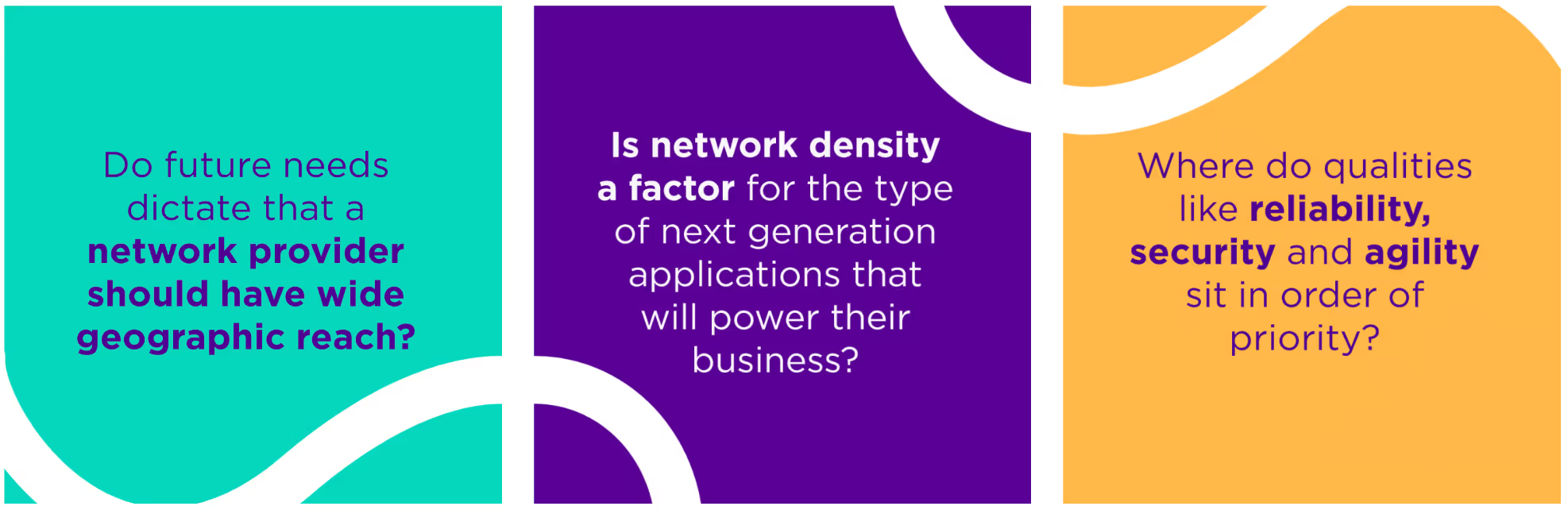
To be future-ready, you need to ask yourself:
We’re seeing more and more of our own customers turning to IP, driven by cloud and SD WAN.
Since Colt’s acquisition of Lumen EMEA in November 2023 we have expanded our network reach and now jointly operate the AS3356 network, the most peered network globally based on CAIDA rankings. We continue to grow and expand our network, including high bandwidth IP Transit to new European cities as part of global network investment. This includes 400 gigabit per second IP Transit ports across the popular FLAP route, connecting Frankfurt, London, Amsterdam and Paris and boosts previous investment in 400G IP ports in Marseille, Oslo, Prague, Sofia, Stockholm and Zurich.
You can find out more by reading our press release.
Reaching the top starts with resilience from the ground up. Is your network an enabler or a barrier? Go from legacy to limitless
The trend towards IP
In this context it is no wonder that more and more businesses are turning to IP as the foundation to build their tech stack upon. In the last few years IP has emerged as a strong rival to alternatives like ethernet, being seen by an increasing number of decision makers as both secure and cost effective.
More traditional network configurations, some even designed in the 1990s, relied on technologies like inflexible MPLS to host their stack: no longer an approach that’s equipped for the agility and flexible world of today. Digital infrastructure based on IP and its associated technologies lend future-focused CIOs the flexibility and scalability that their network needs, protected by SLAs that support product and service delivery, cloud-based app adoption and remote working.
TF1 is a television network which has served France since 1935, making it one of the world’s longest-serving broadcasters, boasting a range of channels and on-demand content that can reach almost 20 million viewers during live sporting events. TF1 turned to Colt for its IP VPN multi-cloud solution as well as our IP access, Dark Fibre and Ethernet services. Finding the right layers of features to build the broadcaster’s connectivity stack was of the utmost importance; a reliable infrastructure that won’t let viewers down.
IP Services meet the objectives of the CIO in a number of ways:
When its time to move on from legacy networks and modernise an organisation's infrastructure, IP delivers.
As the underlay for SD WAN, it provides the reliable, secure and high-speed foundation that lets it live up to its potential. SD WAN enables fast reconfiguration of routing and access policy rules and so helps boost business productivity in ways that are not possible with older network standards. SD WAN is also the perfect on-ramp for the cloud, meaning customers can split workloads across multiple cloud platforms in ways that would be unimaginable with legacy infrastructure. Digital infrastructure companies are now able to suggest ‘the greenest path’ between two ports, for example, meaning this move towards modernisation can also produce effective, less impactful ways of networking.
Customise access types, security options and connectivity to save costs and improve efficiency.
The optimal network partner will save you from having to plough resources into developing relationships with multiple networks across whatever region you choose to operate in. Managing your services from end-to-end, whether over your service provider’s own network or via their local partners, should form an important part of your agreement too. To reduce expenditure further, they should offer peering infrastructure that can exchange traffic with hundreds of networks directly, acting as an aggregator between you and the constellation of partners that make up your network which could lead to reduced contractual costs in the long term.
A good DIA service is the antidote for the kind of complexity that can commonly hinder a CIO.
An SDN-enabled self-service platform irons out this complexity, providing easy real-time connectivity between data centres, enterprise buildings and cloud service providers around the globe. It lets the CIO define their own experience and tap into benefits like online ordering, cutting out manual processes and automating through API integrations. IP also allows for the kind of visibility CIOs need to see what’s going on, from the centre of the organisation right out to the network edge. It should come with online performance reporting and a way to look at traffic utilisation, interface availability and billing data in real time. Along with greater simplicity should come greater security. Matching your IP with the right security add-ons like DDoS mitigation to filter attacks without the necessity for human intervention means legitimate traffic can flow through your network unimpeded.
With IP Services, the future is assured.
IP delivers where decision makers need a highly performant and reliable service specifically designed for modern business use cases. IP network services are fundamental building blocks of modern communication, supporting various infrastructures and applications that range from collaboration tools to video streaming. Enterprises need IP to help them future-proof their IT strategy, making it as agile and growth-friendly as possible.
In a world where the role of the CIO has shifted from trusted IT operator to business strategist, they must find ways to ensure that networks are enabling the business to grow and not hold back transformational goals. This means they need infrastructure that supports low latency, strong security, maximum agility, global edge connections, reduced cost, and high speed of delivery.
What to look out for when choosing a connectivity partner:
Before making a decision that has strategic importance for the future of the organisation, ask your prospective provider the following. Do they:
- Have a robust, global network that can offer the reach and bandwidth your business requires?
- Enjoy extensive peering agreements that can ensure more direct routes and better performance?
- Adhere to strong Service Level Agreements that feature guarantees on uptime, bandwidth and support responsiveness?
- Have a track record of managing Autonomous Systems effectively for optimal routing?
- Offer a flexible pricing model that aligns with your business's traffic patterns and budget?
- Have a strategy of ESG by design, underpinning the solutions they create with carbon emission reduction as a constant objective?
Reach out to us
As a leading provider of global digital infrastructure, we understand the importance of providing on-demand products that support a business’s strategic ambitions. Our portfolio has IP services to match.
Colt’s recent acquisition of Lumen EMEA builds out these capabilities considerably, adding new points of presence (PoPs) across Europe, the Middle East and Africa. Businesses that need a reliable digital infrastructure demand efficient global internet routes that connects data and sends it where it needs to go.
To speak with our solutions experts or sales teams, visit our Contact Us page to get in touch.